
There’s a strange moment that happens after a good client meeting.
You hang up the call, energized. You finally understand what the client wants.
You see the path. You actually want the project. For a split second, everything feels possible.
And then reality taps you on the shoulder.
You still need to write the proposal.
That’s where the momentum breaks.
Not because you’re unprofessional or unprepared,
but because proposals pull you into a different kind of work — the slow, heavy kind.
The kind that asks you to switch from creator to administrator. The kind that drains every bit of clarity you just earned.
Most creators don’t lose deals because of skill.
They lose them because of the time between the meeting and the moment the proposal gets sent.
Let’s talk about why.
1. Proposals Take Too Long (and You Know It)
If you’re honest, proposals don’t take an hour.
They take all weekend.
You open a blank doc.
You scroll through old projects.
You paste pieces from three different files, which don’t match.
You stare at the screen trying to remember how the client phrased that one line that actually mattered.
By the time you’re done, the spark from the meeting is gone. The proposal reads flat because you’re exhausted. And the client — who was excited two days ago — has moved on to something else.
Not because you weren’t good.
Because you weren’t fast enough.
Not fast in the “hustle harder” way.
Fast in the “keep the emotional momentum alive” way.
2. You Don’t Know Where to Start — So You Don’t
It’s embarrassing to admit this out loud, so let’s just put it here:
Most creators don’t actually know what a “perfect proposal” looks like.
You know your craft.
You know how to design, develop, write, solve, or strategize.
But proposals?
Proposals are a different beast. They force you to articulate your process, structure your thinking, and predict every question a client might have — all while sounding confident and calm.
No one teaches you how to do that.
So you wing it. Every time.
And every time feels like starting from zero.
Momentum doesn’t die because you lack talent.
It dies because you have to build the runway while also trying to take off.
3. Pricing Is a Guess — and Guessing Is Stressful
Here’s the part no one likes to say out loud:
Most creators price with a mix of gut feelings, anxiety, and whatever the last client paid.
You’re not bad at pricing.
You’re just human.
You don’t want to scare the client away.
You don’t want to undercut yourself.
You don’t want to explain why the work costs what it costs — even though you know exactly why.
Pricing shouldn’t feel like stepping onto a frozen lake.
But that’s exactly what it feels like when you’re alone with the decision.
And every minute you spend second-guessing yourself is another minute the proposal stays unsent.
4. Fear of Rejection Slows Everything Down
This is the part that rarely gets mentioned, but sits quietly under everything:
If you don’t send the proposal…
they can’t say no.
That tiny emotional loophole is responsible for more delays than any formatting problem or pricing question.
You’re not procrastinating because you’re lazy.
You’re procrastinating because hitting “Send” means being judged — not on your work, but on your worth.
It’s easier to “keep refining.”
It’s safer to “work on it later.”
It’s quieter to stay in the unfinished space where rejection hasn’t happened yet.
But proposals aren’t meant to be emotional minefields.
They’re meant to be bridges between possibility and partnership.
So What Happens When the Proposal Writes Itself?
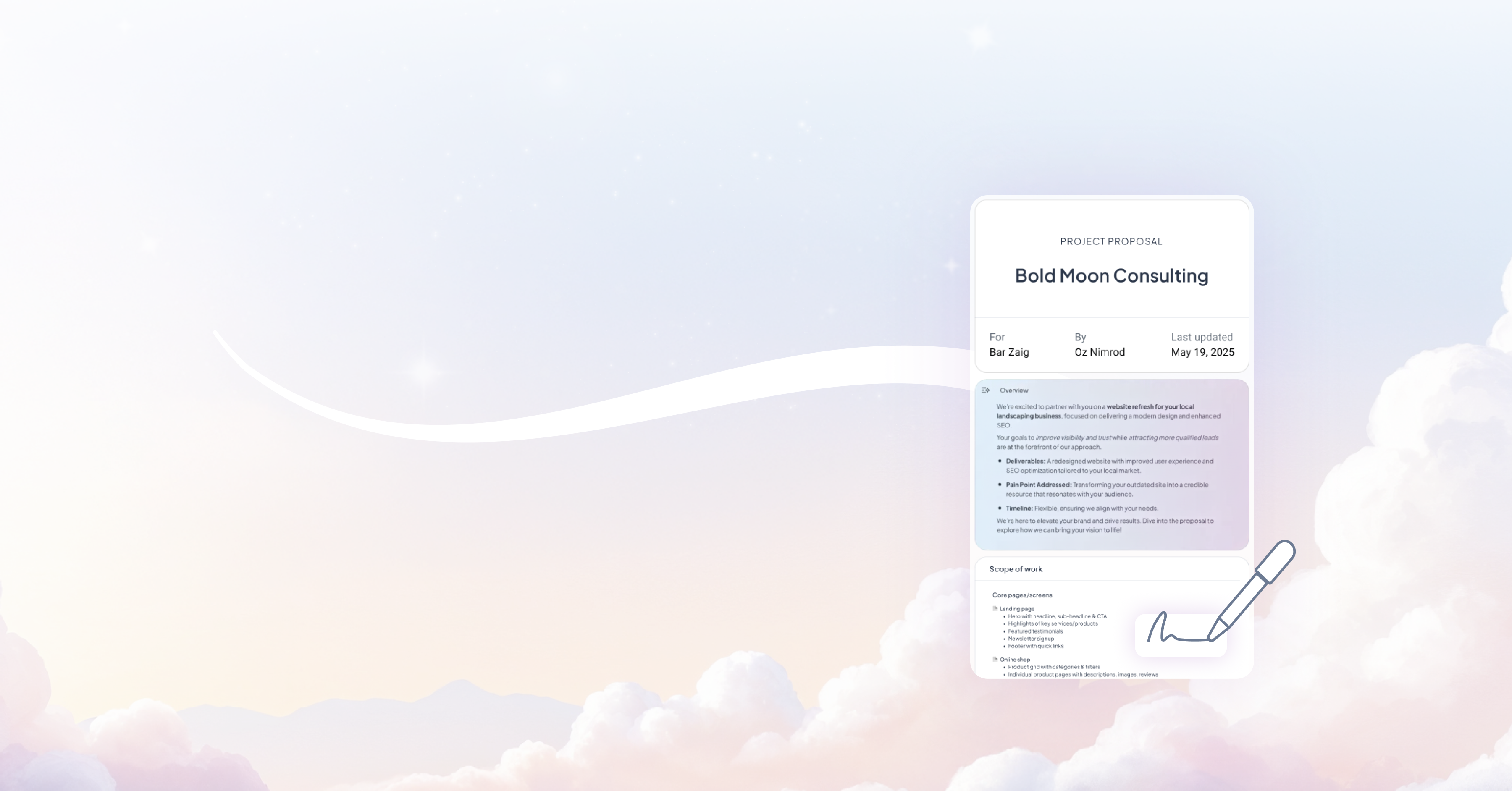
When the notes from your meeting are captured automatically…
When they turn into structure instead of stress…
When the pricing isn’t a guess but a reflection of real scope…
When the blank page never appears…
When the document that once took days now appears in seconds…
Something quiet and powerful shifts.
The proposal stops being a barrier.
It becomes momentum.
It becomes the clean continuation of the call you just had — not a new mountain to climb.
You get to stay in the flow.
You get to follow the energy.
You get to send with confidence instead of fear.
The speed isn’t about working faster.
It’s about removing everything that slows you down.
The Hopeful Part (The Honest Kind)
The truth is: you don’t need another productivity hack.
You don’t need to “try harder.”
You don’t need to become a better administrator.
You just need less friction between knowing what the project is…
and being able to show it clearly to the client.
When the path from meeting to proposal becomes effortless, everything else becomes lighter:
Your confidence.
Your communication.
Your pricing.
Your presence.
Your yeses.
The work you love gets more room to breathe.
And you finally get to run your business in a way that feels like you — not the version of you trying to survive your inbox.
This isn’t about speed for the sake of speed.
It’s about reclaiming momentum, clarity, and calm.
And for the first time, that’s actually possible.